
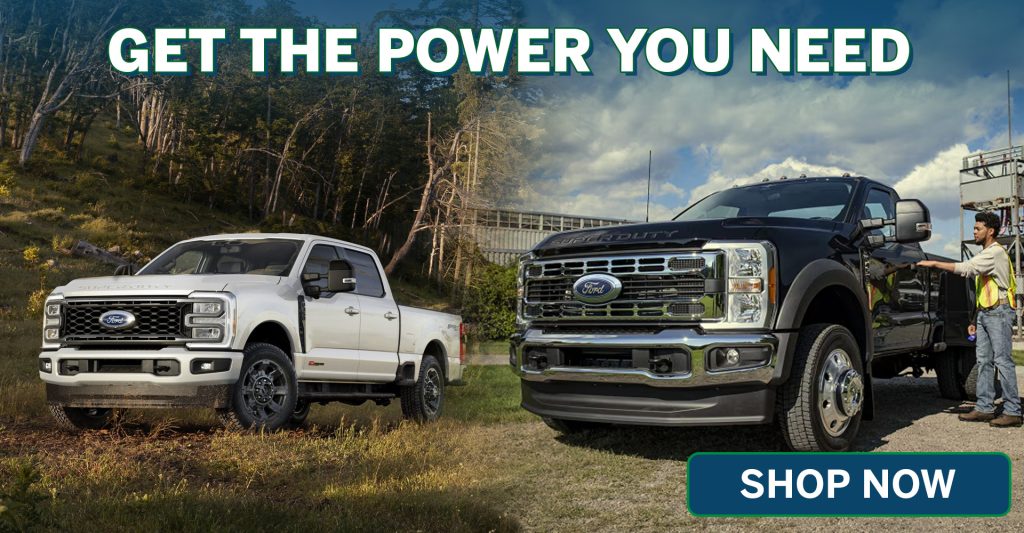
Finding the Perfect Ford Super Duty Fit
Buying a heavy-duty pickup can get difficult when your trailer, payload, and daily route start pulling in different directions. For shoppers comparing the Ford F-350 vs. F-450, the real answer depends less on bragging rights and more on how often you tow heavy, how much weight sits in the bed, and how tight your worksites or campgrounds are.
Within the Ford Super Duty lineup, the Ford F-350 and Ford F-450 can look close on paper but behave differently in real use. In this guide from Portsmouth Ford, we’ll break down the differences between the Ford F-350 and F-450 in practical terms so contractors, farmers, RV owners, and equipment haulers can match the truck to the job rather than chase the highest number in the Ford F-Series lineup.
What Is The Difference Between the Ford F-350 and Ford F-450?
About the Ford F-350
The Ford F-350 sits at the versatile center of the Ford Super Duty lineup. It serves buyers who need serious towing capacity and payload without moving immediately into a more towing-specialized truck.
Its real strength is range. With SRW and DRW options, multiple cab configurations, different bed length combinations, available diesel engine power, and modern trailering tech, the Ford F-350 often serves as the practical ceiling for contractors, RV owners, and farmers who need capability but still care about daily drivability.
About the Ford F-450
The Ford F-450 is the towing-focused pickup step for buyers who want more control with larger trailers. It is still a pickup in the Ford Super Duty lineup, even though its capability overlaps with some medium-duty truck use cases and can change how buyers think about trailer size and job planning.
Its real-world appeal comes from confidence. For equipment haulers, large fifth-wheel owners, and drivers who spend long days towing in wind, on grades, and in tight spaces, the Ford F-450 will feel less strained and easier to place than its size suggests.
Towing and Trailer Control
The biggest reason shoppers compare the Ford F-350 vs. the F-450 is towing. Cab configuration, bed length, wheelbase, 4×4, axle ratio, engine choice, and hitch type all affect the final Ford F-350 vs. F-450 towing capacity rating. A gooseneck or fifth-wheel trailer changes the decision because the pin weight transfers a substantial load onto the truck itself. The Ford F-450 is often chosen when towing is not occasional but routine, especially for large RVs, enclosed equipment trailers, and repeated long-distance pulls where steering confidence and trailer stability reduce driver fatigue.
For heavy but not constant max-stress equipment or dump trailers, a properly configured Ford F-350 often makes more financial and practical sense, and can handle towing up to 38,000 lbs. For large fifth-wheel RVs, repeated mountain grades, crosswinds, and tight campground turns, the Ford F-450 usually feels more composed because it’s built with a towing-first mindset and can tow up to 40,000 lbs.
Fifth-Wheel and Gooseneck Use Cases
A Ford F-350 Dually is often enough when the trailer is heavy, but the owner also needs strong bed payload headroom for tools, fuel, or job materials. That balance matters to contractors and farmers who do not want every truck decision optimized solely around the trailer.
A Ford F-450 makes more sense when heavy-pinned weight towing is common, and maneuvering is part of the workload, not an occasional inconvenience. Long gooseneck-trailer days reveal small differences in steering, stability, and control, and those differences become costly when the truck is used for revenue work.
Trailering Tech That Reduces Stress
The Ford Super Duty can be equipped with useful towing aids, including Pro Trailer Hitch Assist™ and Ford Co-Pilot360®. These systems matter most when the trailer is large enough that small alignment mistakes, lane drift, or poor visibility create real risk. While some automated trailer features can have their quirks, Pro Trailer Hitch Assist significantly enhances the towing experience. When the trailer setup is consistent and sensors are unobstructed, this technology can really shine. It simplifies the process, allowing drivers to focus more on what matters most: achieving accurate trailer setup and ensuring the right tongue weight. With Pro Trailer Hitch Assist, drivers can enjoy greater ease and confidence while towing, making the whole experience smoother and more accessible.
The category winner for towing and trailer control is the Ford F-450. Frequent heavy towing highlights the Ford F-450’s control, maneuverability, and towing-oriented design.
Payload and Bed Work
Payload means everything carried by the truck, including passengers, tools, hitch hardware, fuel, aftermarket accessories, and any pin weight or tongue weight pressing down from the trailer. Many buyers overestimate what they can haul because they focus on towing capacity while ignoring how quickly real-world payload disappears.
This is where the Ford F-350 vs. F-450 becomes less intuitive, as both provide up to 14,000 lbs. GVWR. Depending on configuration, the Ford F-350 can be the sharper choice for bed-focused work because payload-oriented builds may leave more usable room for pallets, salt spreaders, toolboxes, skid steer attachments, or auxiliary tanks without shifting into a more specialized towing setup. For a service truck, farm truck, or mixed contractor use, that flexibility matters. A truck that tows well but runs out of payload after adding crew members, a hitch, and job equipment is not actually sized correctly for the work.
For buyers who carry serious weight in the bed as well as tow, the Ford F-350 often delivers the more useful payload-focused balance.
Maneuverability and Turning
Many buyers are surprised that a Ford F-450 can turn tighter than a Ford F-350 in many configurations. The reason is not magic but hardware: the Ford F-450 often uses a wide-track front axle and steering geometry designed to improve the truck’s turning radius despite its larger, towing-focused footprint.
That difference shows up at crowded fuel stations, on older town streets, at jobsite gates, and in campgrounds where a long trailer punishes every extra correction. A tighter turning circle can reduce multi-point turns, lower stress, and shorten the time spent blocking traffic while backing a trailer into place. The tradeoff is that bigger hardware and a wider stance can add cost and complexity. Parking ease, tire wear, and tire replacement cost can all lean less favorably toward the Ford F-450 when the truck is used more as a commuter vehicle than as a tow rig.
Where Tighter Turning Actually Matters
Tighter turning matters most in equipment yards, narrow rural lanes, storage lots, and crowded campgrounds. These are the places where trailer length magnifies every steering limitation. For long gooseneck trailer and fifth-wheel trailer users, fewer corrections can also reduce fatigue. Over a full season of towing, easier maneuvering is not just convenience but a productivity advantage.
The Ford F-450’s turning advantage is one of the clearest real-world reasons to move up when towing large trailers and space is tight.
Ride Quality and Daily Driving
The Ford F-350 vs. F-450 ride quality depends heavily on load, tire construction, and suspension tuning. Both are heavy-duty pickups, so unloaded ride comfort won’t feel like a midsize SUV, but the Ford F-350 usually fits daily driving more naturally.
A single-rear-wheel Ford F-350 is often the least disruptive choice for commuting, errands, school runs, and parking lots. Even a Ford F-350 Dually can feel easier to live with than a Ford F-450 when the truck spends more time empty than towing.
The Ford F-450 tends to feel most at home under load, where its design priorities make more sense. A truck optimized for heavy trailer control can feel less relaxed in routine suburban use, which is why honest self-assessment matters more than capability envy.
For daily driving, mixed errands, and less specialized ownership, the Ford F-350 is usually the easier truck to live with.
Fuel Economy and Range
Ford F-350 vs. F-450 fuel mileage should be treated qualitatively because mileage changes with axle ratio, tire selection, speed, terrain, wind, and load. The 6.7L Power Stroke® Diesel V8, rated at up to 1,050 lb.-ft. of torque in certain Ford Super Duty applications delivers serious pulling power, but heavy-duty capability always comes at the expense of efficiency.
The Ford F-450’s heavier-duty components, wider front axle, and tire choices can affect fuel consumption and range. That does not automatically make it the wrong truck, but it does mean owners should plan fuel stops around towing days, not around empty commuting habits.
The trailer’s frontal area often affects range more than buyers expect. A tall enclosed trailer or large fifth-wheel can punish fuel use far more than a modest open equipment trailer, even when scale weight looks manageable.
What Impacts Mileage Most When Towing
Speed, terrain, wind, and trailer shape are usually the biggest mileage variables. Axle ratio and tire selection also matter because they change engine operating range and rolling resistance.
In most comparable real-world use, the Ford F-350 is the more efficient and less costly truck to feed.
Work Configurations, Upfits, and Fleet Fit
For upfit work, the right answer depends on GVWR, axle ratings, and what the truck must carry before a trailer is even attached. Service body, flatbed, dump insert, plow, and auxiliary fuel system installations all change the weight distribution, so the truck should be chosen based on the final working build, not the stock truck on the lot.
This is where many Maine buyers around Portsmouth, Exeter, Dover, and Concord ask the right question: should the truck fit today’s work or next year’s growth? For mixed seasonal demands such as landscaping in spring, towing equipment in summer, and snow work in winter, the Ford F-350 often fits a broader range of jobs without overcommitting to one specialty.
The Ford F-450 becomes more compelling when the fleet role is trailer-heavy and repetitive. Hotshot-style hauling, large equipment moves, and frequent heavy RV towing reward the Ford F-450’s stability and maneuvering edge more than a mixed contractor schedule would. For broader upfit flexibility and mixed fleet use, the Ford F-350 usually fits more jobs with fewer compromises.
Key Considerations for Your Needs
When choosing between the Ford F-350 and the Ford F-450, the decision ultimately comes down to your specific needs. The Ford F-350 stands out for most mixed-use owners, offering superior configuration flexibility, easier daily drivability, and robust payload-centric builds. On the other hand, if frequent heavy towing is a priority, the Ford F-450 excels with its towing-focused setup, enhanced steering geometry, and wide-track front axle, enabling better control when towing large trailers.
For those comparing a Ford F-350 Dually vs. a Ford F-450, the choice typically boils down to payload needs versus the need to tow heavy fifth-wheel or gooseneck trailers. It’s also important to consider running costs, as the Ford F-450 may incur higher tire replacement expenses and require a more specialized ownership profile. Starting your comparison with the payload sticker on your door jamb, the loaded weight of your trailer, and your monthly towing frequency will lead you to the most informed decision.
Which Model Should You Choose?
Our team’s conversations with serious truck shoppers often circle the same issue: when does moving up in capability actually improve the job, and when does it just make daily life harder? The Ford F-350 vs. F-450 debate is usually resolved by looking at trailer frequency, not just trailer size, and by comparing a workday with a non-workday.
Choose Ford F-350 if:
- You need a balanced mix of payload and towing for construction, agriculture, or mixed contractor work.
- You want SRW or DRW flexibility and a truck that is easier to park and use daily.
- You are comparing F-350 Dually vs. F-450 because your trailer is heavy, but bed cargo and daily drivability still matter.
Choose Ford F-450 if:
- You tow large fifth-wheel or gooseneck trailer loads frequently and want more control.
- You regularly maneuver long trailers through tight yards, campgrounds, or job sites.
- You are planning for workload growth in which repeated heavy towing will become the norm, not the exception.
Which Ford Super Duty Fits Your Work?
For most mixed-use owners, the Ford F-350 is the smarter recommendation because it covers more real-world jobs without becoming unnecessarily specialized. For frequent heavy-tow users, especially those hauling large RVs or equipment trailers through tight spaces, the Ford F-450 earns its place with better trailer-focused confidence and maneuverability.
The right answer still comes down to the exact truck, not just the badge. Bring your trailer GVWR, estimated loaded weight, hitch type, typical cargo list, and towing frequency when comparing builds, and our team at Portsmouth Ford can help shoppers from Portsmouth, Exeter, Dover, and Concord, as well as nearby Maine communities, sort through Ford Super Duty capability and available models.
FAQs
Do Ford F-450 trucks turn better than Ford F-350 trucks?
Often, yes. Many Ford F-450 configurations use a wide-track front axle and steering geometry that can produce a tighter turning circle, which helps with large trailers in tight spaces.
Which Ford F-350 should I stay away from?
Avoid any Ford F-350 that does not match your actual workload or lacks documented maintenance. Check the door-jamb payload sticker, hitch setup, axle ratio, and signs of heavy towing wear before deciding.
Is a Ford F-450 considered a medium-duty truck?
The Ford F-450, in pickup form, is generally considered a heavy-duty pickup within the Ford Super Duty family. Its capabilities can overlap with those of medium-duty trucks, but classification can vary by GVWR and registration rules.
Is the Ford F-450 better for towing than the Ford F-350?
For frequent heavy towing, many buyers prefer the Ford F-450 because it is optimized for control and maneuverability. Exact towing capacity still depends on configuration, so compare the towing guide and the real loaded trailer weight.
Connect with us


